


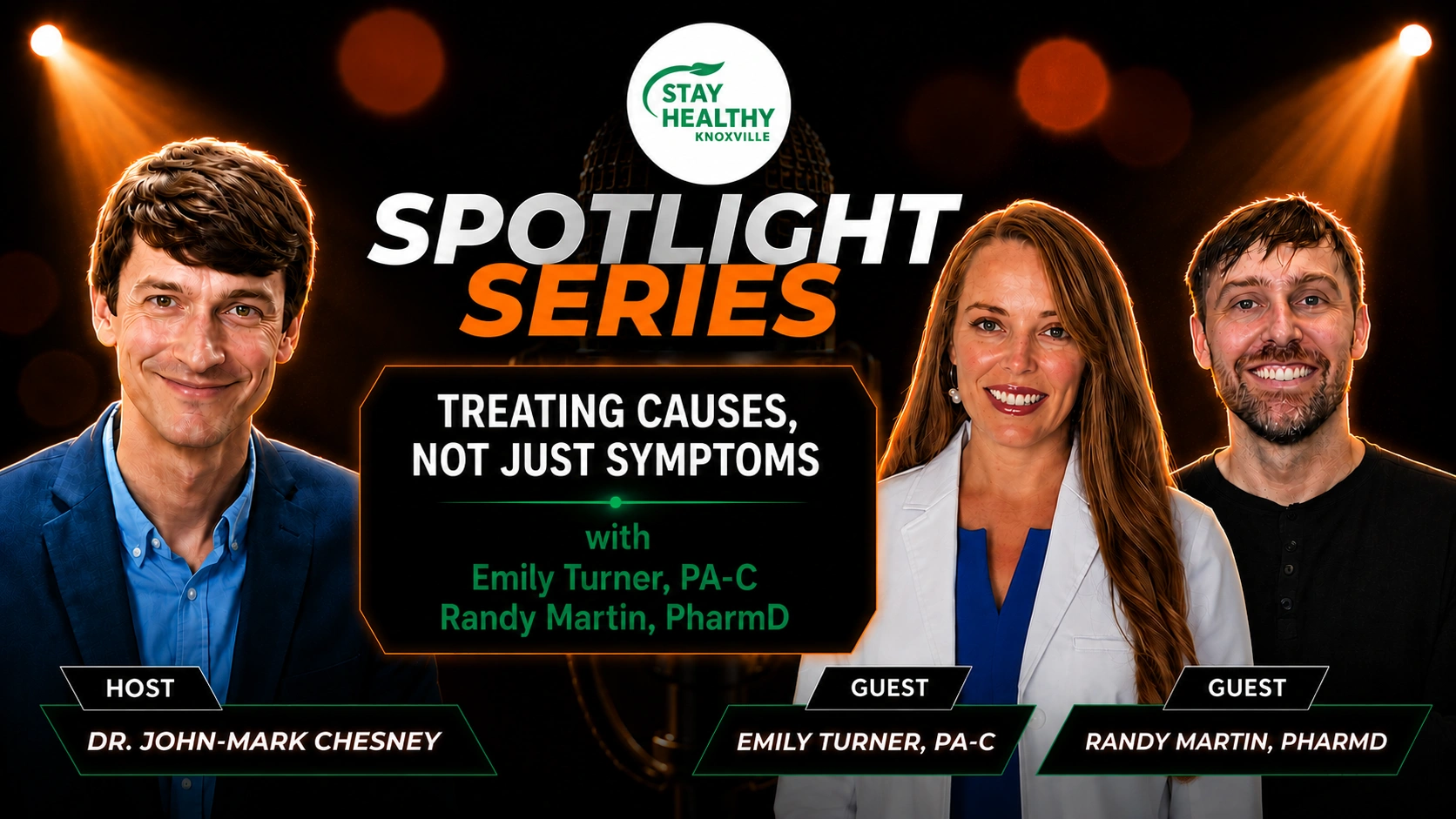
Spotlight Series topic: Treating Causes, Not Just Symptoms: Omni Functional Wellness
Guest Name: Emily Turner & Randy Martin
Guest Credentials:
Emily Turner, PA-C, Bachelor’s Degree in Dietetics – University of Kentucky, Master’s in Physician Assistant Studies – Sullivan University, Advanced training through The Institute of Functional Medicine, Advanced training through The American Academy of Anti-Aging Medicine
Randy Martin, PharmD, Doctor of Pharmacy – University of Tennessee, Co-founder of Omni Functional Medicine.
In this episode of Stay Healthy Knoxville, Dr. John-Mark Chesney sits down with Emily Turner, PA-C, and Randy Martin, PharmD, of Omni Functional Medicine to discuss a different approach to healthcare—one focused on identifying and addressing the root causes of chronic symptoms rather than simply managing them.
Together, they explore what functional medicine is, why so many people continue to struggle despite being told their labs are normal, and how factors such as hormones, gut health, stress, metabolism, and inflammation can impact overall health and well-being.
Whether you’re dealing with fatigue, weight gain, digestive issues, autoimmune disease, chronic pain, or simply aren’t feeling your best, this conversation offers valuable insight into how a more personalized approach to healthcare may help uncover missing pieces of the puzzle.
Listen to this episode to learn:
- What functional medicine is and how it differs from traditional healthcare
- Why patients can still feel unwell despite “normal” lab results
- The importance of looking for root causes instead of just treating symptoms
- How hormones, gut health and stress influence overall health
- Practical steps you can take to improve your health and energy
Address of guest’s business:
10805 Kingston Pike
Suite 100, Knoxville, TN 37934
Emily Turner: It’s nice to be here.
DR. JOHN-MARK CHESNEY: Yeah. Well, um, wanted to start off with, um, hearing some of your guys’ backstory. So, we’ll start with Emily. Uh, tell us a bit about your journey into healthcare and what really led you into functional medicine.
Emily Turner: Yeah. So, um, my journey into medicine started at a pretty young age. I grew up on a farm and for a very long time thought that I wanted to be in veterinary medicine, just like helping out around the house and grew up with horses and dogs and cats and, you know, all sorts of things around the farm. Um, but it wasn’t until I was in high school that I really started, you know, shadowing and looking into different areas of medicine and kind of made the switch over into kind of the the human world of medicine. Um, through just like shadowing and kind of exploring different opportunities, I came across the PA profession. Um, and just really felt like it aligned kind of with my personality. I loved kind of the ability to collaborate with also like um kind of the the independence that being a PA allows. Um so that’s kind of what started my journey there. I always kind of knew I wanted to be a little bit more holistic and kind of had that interest. So um ultimately started my education in dietetics like you said um before going on and becoming a PA. Um started my career actually in emergency medicine. Um, so I spent the first four years working in the ER. Um, kind of in the midst of COVID and um, a lot of changes that we saw in the healthcare system. Um, learned a ton, got a ton of great experiences, had, you know, many great mentors. Um, but always kind of knew that I really wanted to be, you know, more in the outpatient world, a setting where I could, you know, come alongside patients and make a treatment plan, build some rapport, um, kind of see them grow throughout their journey. and so transitioned out of the ER and actually went into primary care for a little while. Um, fortunately was able to work for a primary care office that was um, independently owned and a little bit more open-minded. And so that’s when I actually started working um, with hormone therapy um, and kind of started looking outside the box of just like the traditional kind of algorithms with treatments with, you know, XYZ symptoms equals this prescription. Um, and that’s actually where I met Randy and we started working together. Um, and then, um, after kind of having that experience, really kind of knew I wanted to jump in with both feet and made the transition to functional medicine. Um, haven’t really looked back since. So,
DR. JOHN-MARK CHESNEY: awesome. Well, thank you for sharing. So Randy, kind of similar question for you as far as what led you into pharmacy and then how did you then become interested in this kind of more alternative or holistic, you know, practice with uh functional medicine?
Randy Martin: Sure. So, as you mentioned, I went to the University of Tennessee and I think like a lot of people, I wasn’t sure what I wanted to do when I first got there. Uh, I was really interested in in um physical therapy was really kind of what I was doing. Um, I did some athletic training a little bit with some of the athletes at UT and then started taking some chemistry classes. I was like, hey, I I really enjoy this. Um, got into some physiology and was like, well, think I want to kind of go into more of a medical field. Um, started looking into it and and landed in in pharmacy. Um, I got accepted and was like, “Hey, let’s let’s go do this. It sounds really interesting to me.” Uh, I was a little naive and I didn’t really know a whole lot about the field. Um, kind of got in, um, started learning and was like, “Hey, this is great. I can help people and I think this is going to be a big thing for me and it’s going to align with my values.” So, um, after I graduated, I got into I actually started working as a pharmacy manager at Kroger for about seven years. And then after that, I helped open up an Ingles pharmacy. Um, and through those seven years, I kind of realized that most of my patients were coming back getting the same medication over and over, and they were never getting better. We were really just put treating um the symptoms and kind of uh taking care of if you want to associate it with a tree, we were kind of just taking care of the leaves at the end and trying to keep them from falling off instead of working on the roots and trying to make them healthy. Sure. Um, so about 8 years into practicing, I decided just to to to quit. And with the I wanted something wasn’t such as a like a cookie cutter approach. Whenever we were working with the corporates, it was like you couldn’t really think outside of the box and do things different. You just kind of had to fall in line. And and I think I don’t want to come across really negative, but it just didn’t associate with with what I wanted to do. So um so I went in and started looking to independent pharmacy. So I just kind of quit started looking around trying to find anybody that would take me on. Um so I did that for about 2 years and just trying to learn what other people were doing that was a little bit different than a corporate pharmacy setting. Um, I did that as long as I could until finally I it was hard to find a full-time job in in independent pharmacy. Uh, cuz most people that get there, they never leave cuz it’s amazing. Um, so I did that as long as I could until I ran out of money and had to go back to corporate um, pharmacy. Started working at CVS for I was there for about 3 months and I got a phone call one day from an old friend that had offered a job at a compounding pharmacy and she didn’t want it cuz she was working at Children’s Hospital and she loved it. So I said, “Yeah, I’ll go interview with them.” Uh, interview went great. Um, they liked me, they brought me on. And so I started that’s how my got into compounding pharmacy and it was like a whole new world of working in the functional with a lot of functional practice people and we were really specializing in hormone replacement therapy at the time um including like thyroid testosterone estrogens and we also worked some with um immunosuppressed people. Let’s say you have like autoimmune disease we would do things for them as well. Um, I was there for about 10 months and the guy that owned it like, “I’m retiring. You can either buy it or I’m going to get somebody else.” And I was like, “Let’s do it.” So, I ended up purchasing the business. Um, I was there for five years. Um, we grew really quick. Uh, I loved it. Um, I got to meet a lot of people practicing functional medicine. Um, that’s also where I met Emily. And one reason I wanted to partner with her is because the way she practiced resonated with me. Uh there’s a lot of different thoughts and like uh theories on how people practice functional. Um and I got to see a lot of them. And Emily was really I I just really like the way she practices. She starts at the root. She’s very responsible with what she does. She and just like a methodical approach. Like it was just really I like it. And it’s it’s I was like, you know, that’s somebody I could do a business with. Um, that was just kind of a segue to Emily. Back to the pharmacy. We had gotten to the point where I just it was too big for me to handle on my own. I brought on some business partners. Um, they had a little bit different vision than I did. They wanted to go national. I really like the the local approach. I really enjoyed working with people here in Knoxville. They wanted to ship to all 50 states and and make it a lot bigger than what I what meant something to me. So, I was like, “Well, you know, guys, I’m just going to branch off, do my own thing.” Um, I I talked to Emily. We met. We actually went to a local restaurant called Fuji and it’s like, “Hey, you want to do this?” And she said, “Yes.” And we actually went and rented a place that day. So, that’s and that’s where we’re at. So, we actually it was a friend of mine had a place um I called and said, “Hey, do you know who’s rent owns this?” And she said, “Hey, we I actually own it.” So, uh we went and saw it and told him we wanted it and uh we’re not looking back. We love it. Um we hope that we can make a big difference here in Knoxville. We we really love what we’re doing.
DR. JOHN-MARK CHESNEY: Yeah. Um well, thank you guys for sharing, too. So, you know, we want to get into um you know, I think a lot of people, a lot of our listeners um probably heard of functional medicine, right, as far as the term um but what is, you know, really getting into what does that actually um mean? So, um and a little bit of background too just for our listeners. So, uh so you guys, um really started your practice Omni Functional Medicine uh beginning of the year, right? recording this in 2026, correct?
Emily Turner: Yes.
DR. JOHN-MARK CHESNEY: Um so um so really six months in about six months in um uh paint’s still a little fresh there in the building. The building looks awesome. I came and um visited there last week. So um an awesome space um excited for you guys. Um, and yeah, cool to hear how um how you guys connected and um I’m really interested to hear the kind of the rest of this interview too, just um the mending, if you will, of somebody with a pharmacy um perspective, right, with somebody with uh more of a, you know, a PA um integration, you know, with that functional medicine. Um maybe um what if um Emily how did like maybe just kind of a short overview of how do you guys work together uh with patients and then why don’t we get into kind of some of that functional medicine but for our listeners like how do you guys work together?
Emily Turner: Yeah. Um I feel like we found a really good groove as to how to like kind of play off of each other. um you know as a PA I and especially like in the hospital system system I was very accustomed to working with you know colleagues, nurses, supervising physicians, uh clinical pharmacists, those sorts of things. So I feel like it plays out kind of similarly um in this role. Um Randy has a ton of experience obviously from the compounding side of things and understanding like you know very good about the patho and the pharmacology and just like how that works at the cellular level. Um but he’s also done a lot of training in functional medicine itself. Um I think he even pursued like health coaching kind of thing um at one point like certification wise. Um but for most patients I would say if you’re seeing me or you’re seeing Randy you’re really getting both of us in both cases because we do a lot of review together. Um we’ve worked together to kind of develop different protocols for different things that we see and just making sure that we’re picking the best um products and hitting the right pathways. um for each patient in each specific condition. Um so yeah, that’s kind of how we do things. He also, you know, I see a lot of patients um for just like new patient appointments, follow-up, those sorts of things. But he also offers like a health coaching side of things. And so a lot of patients that are going through like our gut work type protocols or like detox type protocols, we’ll see him kind of intermittently throughout that process. um just kind of as a way to be higher touch to kind of follow up on those lifestyle kind of things to make sure from you know a supplement or you know a pharmacology standpoint that they’re doing well with their therapies. Is there any way we can optimize that? Um so I feel like it it fits where very well into what we’re doing.
DR. JOHN-MARK CHESNEY: Awesome. Well um well tell us you know as a listener who has maybe heard the term but doesn’t really know like what is what is functional medicine? How’s it different um you know from traditional medicine?
Emily Turner: Yeah. Um so when I think about functional medicine I think one of the main things that is different is just the time that we take to really kind of take a step back and look at the entire picture. Um you know when you think about kind of conventional medicine and you know I’ve certainly been in this box it’s kind of rapid fire. um you know, you’re seeing your p your uh your patient for 10 or 15 minutes, your provider has four appointments in the hour um in most cases. And so functional medicine really just like takes the time and the perspective to take a step back, look at the whole body, how all the systems interconnect. Um and then we really try to kind of uncover those underlying triggers or like root causes um for the symptom or the problem that you may be having.
DR. JOHN-MARK CHESNEY: Um great. I um very much identify with uh with with that appreciation uh was really why I started Simply Physio is kind of the same thing as having to you know be rushed with appointments and seeing you know patients every 15 you know 30 minutes or multiple patients you know at once like there’s an element of having time right so that’s what we do with our patients too is you know it’s it’s individual based it’s one-on-one and when you have that time with your patient you and utilize it in a much deeper and meaningful way of connecting the dots. And it sounds like, you know, what we do here as far as the musculoskeletal world and movement um that you’re using that time, you know, to help um you know, connect to other dots of of of medicine. So So yeah, that’s cool. Cool to hear. So um Randy, when you were talking earlier too, you mentioned um you know, finding uh the root cause. Um did yeah either one of you mind kind of expounding on that? Um what does that actually mean? Again a lot of people will you know um it’s a phrase that you know patients say oh yeah I want to you know obviously get to the root cause but like what does that actually mean?
Randy Martin: Yeah. the and when we look at the root cause, let’s say an example when let’s say arthritis, uh a lot of times if you go to your conventional medicine practitioner, they’re probably going to look at anti-inflammatories and try to treat the pain that you’re having with your arthritis, but what what’s why do you have arthritis? Like what’s going on? Why is your immune system overactive? So, we go we dig a little deeper and we try to find out like do you have leaky gut? is do you have bad bacteria overgrowth? Um I mean there that’s just one example. There’s so many different things, but we try to find out what caused it in the first place. Uh cuz we can keep using anti-inflammatories like ibuprofen. Um it may help with the pain, but we’re not treating it. We’re just putting a band-aid just like uh if you have a cut on your skin and you keep reopening it like you didn’t treat the problem. You got to you got to heal the skin. So we try to find out where it’s originating from uh the source of the problem and and and when we that’s why you see a lot of people especially in functional medicine they will focus on the gut because 70% of your immune system or more is located in your in the gut. Um, and if you start really looking into it, a lot of diseases are due to like a overactive or an immune system that’s not acting appropriately. Um, so whenever we treat the gut, even though you may not even have gut symptoms, um, when we start working on that, we can decrease inflammation through the whole body. Um, and that can actually start treating that root problem. So, a lot of times when we’re working, again, this is just an example. I keep going to arthritis in the gut, but a lot of times if we’re working with people with arthritis and we treat the gut, their arthritis symptoms do get better, especially if that was the root cause. Um, obviously there are other root things and we would dig into it doing a a lot of specialized lab work which Emily can probably talk more on cuz she’s really well versed in that. But the we dig in to try to find out what other issues may be going on that could lead to the symptoms that you’re having.
DR. JOHN-MARK CHESNEY: Yeah. Well, um that’s kind of um Randy kind of led into that the question there for you, um Emily, as far as um understanding the root by some of the labs. Um so, um I have at least um some understanding of functional medicine and um maybe explain a little bit more of how that’s different and why that’s important, Emily.
Emily Turner: Yeah. So, as far as kind of our stage of things when we go into evaluation, so you know, typically during those appointment times, we’re collecting a really good history. We’re kind of identifying, you know, the issues. We’re doing a good physical exam. And then from that, we’re going to take that information and kind of put together a comprehensive workup plan. And so that can sometimes look like primarily lab work, blood work. Um, I do a lot of the standard panels that like your primary care would, but outside of that, we’re going to go kind of far beyond kind of those surface level kinds of labs. So, looking at things like markers for inflammation and markers for your hormones, um, more sophisticated like lipid panels to be able to look at your metabolic um, profile. And then outside of just looking at lab work, you know, sometimes we’ll go down kind of the pathway of looking at the gut. Um we do a ton of gut work and functional medicine. There are several different um tests that kind of lay out what’s going on in the gut very well depending on that person’s specific concerns, but tests that look, you know, at the microbiome. They look at um the immune function of the gut, the inflammatory burden of the gut, how you’re digesting. Um so those can be really helpful. We look at, you know, more sophisticated hormone panels um with like DUTCH testing. Um we also do a lot of cortisol work. So, um I know a lot of people out there, you know, lots of buzz about cortisol right now. So, um a lot of like patients will come to me from their primary care provider and maybe they’ve had like a blood cortisol test. It’s really not helpful um because it’s just this one speck in time and the timing really matters. And so we do a lot of salivary cortisol tests that actually trend like throughout the day how your cortisol is looking. Um so there’s a lot of different tests outside of just kind of that initial panel you would get kind of on a screening blood work um from like a general practitioner that can really kind of help us to kind of figure out what might kind of be the trigger for things.
DR. JOHN-MARK CHESNEY: Um yeah, great. So, so yeah, so understanding that you know it’s really important um what information you’re looking at, right? Um and you know what you’re um understanding like even you talked about the the cortisol test and appreciating that you can test that in different ways and you get a different information and you know knowing um maybe a a more um a better way if you will to you know test for it. um gives you a a better appreciation of not just like a time and space um or at the moment, but more of a a general overview of like, hey, is this a problem um or not? But um but having that at your disposal of, you know, seeing all these other pieces allows you, it sounds like, to really dig dig deeper um in um finding finding a solution. Um so um is that a good kind of summary there?
Emily Turner: Yeah, absolutely.
DR. JOHN-MARK CHESNEY: Okay. Well um I think the other piece too and maybe for you know um probably appreciated an answer for both of you guys. So, you know, let’s say you got all this information, right? Um, then what is a treatment? Um, so I’d imagine still like kind of the proposal of the treatment is different than a traditional kind of treatment prescription, right? Um, so tell me a little bit more on that aspect of, you know, let’s say that you know, you got these panels, you got all this information. Um, just generally speaking, what how is that treatment different than a traditional approach?
Emily Turner: Um, yeah. So with anything, I mean, I think sometimes information can feel a little overwhelming, but we’re always going to kind of go back to the patient, go back to what they’re experiencing, and then it’s going to be highly personalized based on what we found in their results and kind of what we’re working towards. Um, we’re never going to take a treatment like we talked about before and just kind of slap it on a symptom and say, “This will fix this.” We always want to kind of go back to what, you know, we’re seeing in those objective results that we’ve got and kind of like how we’re putting those pieces together. Um, our treatments are typically going to be, you know, multifaceted. We’re going to talk about nutrition. We’re going to talk about lifestyle, you know, are you sleeping? Are you moving your body? How are your stress, you know, levels overall? Um, and then with that, sometimes we will augment with like a supplement protocol, um, when that’s appropriate. if we can kind of optimize maybe nutrition status or nutrient status or kind of augment the gut or what have you um with those type of therapies but it’s normally going to be multifaceted um and I sometimes will use prescriptions you know I do a ton of hormone therapy so we’re not at all anti like medication um we want to make sure we’re doing it from you know a holistic type of approach that’s not just you know that band-aid
DR. JOHN-MARK CHESNEY: yeah um So Randy, so I know we talked about compounding. Um, and I’m not sure if that’s part of this answer, too. Um, again, I’ve I’ve um I know that that phrase, but I really don’t know how that makes a difference than non-compounding pharmacy. Um, and I’d imagine that goes into kind of treating more the root cause or I don’t want to put words in your mouth, but tell me talk a little bit on that topic for me for our listeners.
Randy Martin: Yeah. So, in the compounding world, we a lot of functional medicine practitioners kind of lean on us to treat things that you typically can’t get from like a conventional medicine or sorry, from yeah, from a conventional pharmacy. So, we Emily, for instance, will do a lot of hormone replacement therapy if if patient needs um to do that. We typically will do we can do oral compounding. So we can do like a sublingual tablet, we can make a topical cream, we can actually make injectables, but we can al we can customize those doses for every individual patients. So we we have 10 patients. We may have 10 different doses that we’re using. Um, and that’s where Emily’s expertise comes in. And then one reason that I really enjoy working with her is because she’s very I’ I’ve worked with some pract or I saw I didn’t work with but a lot of practitioner would send the same dose for every patient. Um they’d have a starting dose that they always started at and and in my opinion sometimes that would be a little too little high. Um and if we dose too high with hormones we shut down our body’s natural production. So having somebody that actually knows to look at the labs, start at a at a a reasonable point, preferably on the lower end and work up is a lot safer um for patient therapy in my opinion. Um because some people if you’re starting them out too high, you may get those hormone levels that you need, but you’ve also shut down their natural production. So instead of supplementing and assisting their natural production, you’ve just replaced it. And we kind of come from the perspective to supplement what’s needed instead of shut down the body’s natural production and just replace it completely um because we like to keep the natural functions operating as much as possible. Um so being able to compound we can adjust those doses to be able to um keep those level we can basically dose it to treat each individual patient. Um, and that’s kind of where we kind of come in and and help patients not be overdosed on their therapies.
DR. JOHN-MARK CHESNEY: Yeah. Yeah. I mean, it would be the same way like for me, you know, if somebody has back pain, what if I just have the sheet of five exercises that I just give to all my patients with back pain? And yeah, granted that probably helps some people, but um the nuances of back pain can be very different based on their age, based on the type of back pain they have, based on the influencing factors that, you know, we have to customize that instead of just a one-size-fits-all. So, it sounds like it’s very similar, you know, to to you guys just because somebody has I don’t know if hypertension is if that’s a a good example or or or whatnot. um um uh what that condition would be but but that you can really identify like for this patient like we need to um adjust you know this in a certain way.
Randy Martin: Yeah. Yeah. Yeah. I mean that that’s actually very similar just like you were saying. You can’t just give somebody the exact same exercise for everybody that walks in your door. Um and I I like that. Like let’s customize it for them. if their upper back’s hurting, you’re not going to give them lower back exercises just to um just to give them something to do because you may not get the results that you’re wanting.
DR. JOHN-MARK CHESNEY: Yeah. Um All right. Well, um I wanted to understand too, um maybe if there’s there’s a number of things that you guys do. Um and if u you know, I listed off at the very beginning of the intro, you know, things that you help with, whether it be, you know, we talked a lot about hormones or gut health has come up, you know, autoimmune disease, metabolic health, energy. Um, is there a typical patient um, uh, with like certain complaints that you guys maybe regularly see? Um, I’m I’m sure we could do a full podcast on all those topics. Um, but for kind of this the uh, the purpose of this um, podcast to be a little bit more overview of, you know, what you guys do, if you guys do specialize in a certain area, maybe a little bit more than another, uh, maybe we could speak to that first.
Emily Turner: I would say um probably you know absolutely all the things that we’ve talked about do a lot of gut health just because it’s so central to so many things um a lot of hormones but I would say probably one of the most common kind of complaints and this is this is broad but one of the most common things that I see is a patient that walks to the door and they’re just frustrated. Um maybe they’ve seen their primary care two or three times and they’ve seen a couple different specialist and they’re kind of met with the same response of, you know, your labs look okay, your labs look normal, you know, this test was normal. Um but they still don’t feel well. And so they’re kind of like by the time they get to us kind of feel like they’re grasping at straws a little bit. Um, so I don’t know if that completely answers your question, but
DR. JOHN-MARK CHESNEY: yeah, I think I was just more interested in like um what is that patient? What’s the issue that they’re like what’s their pain point, right? How do they get to you because they’re frustrated with this or having this type of issue so that people can identify, you know, my listeners of like, oh, that’s that’s me, right?
Emily Turner: Yeah. see a lot of like chronic fatigue, brain fog, um GI issues, like someone who’s been kind of given the label of like an IBS type of um presentation, but they’re having pain, they’re having, you know, GI symptoms that limit what they’re able to do from day to day. um or you know the typical like a female who is having kind of these vague symptoms that are ultimately at the root of it probably hormonal but um the conventional world is just not um geared towards checking those things and a lot of women when they do come with hormonal symptoms and they may even say like hey I think this is my hormones um providers are very hesitant to even check them because I think we we don’t we’re not trained in how to handle it so we don’t want to to kind of open that box so to say.
DR. JOHN-MARK CHESNEY: Okay. Um and then um one even just you know question too is um as you work with patients um and you know most patients have some sort of provider right that they’ve worked with um or they you know they’re a patient of um how do you how do you work um in in that type of dynamic um kind of what are patients options?
Emily Turner: Yeah. So, I um collaborate regularly with other providers. Um I actually I try to do a really good job when patients are seeing providers outside my office to make sure I have those records. Um there’s even been times I’ve gotten on the phone with those providers just to make sure we’re on the same page and we’re giving really good kind of comprehensive care. Um so I’m happy to collaborate um with providers outside our office. there are times that even I find the need to refer. Um I think one thing that does make us a little bit unique is that um I do have a background in primary care and so I do offer that to my patients um if they want to kind of get their day-to-day healthcare needs and kind of all their preventative things. Um as well as kind of that integrated functional approach all in one place. Um I try to kind of bridge that gap so you don’t feel like you’re running all over town to get, you know, to kind of check the boxes of your care.
DR. JOHN-MARK CHESNEY: Okay. Um well going back to you mentioned a lot about hormones. Um maybe just for our listeners like what would be um um a sign that there’s potentially a hormone imbalance that that people often miss?
Emily Turner: Yeah. So for women, I think a lot of times um especially in younger women, it’s going to show up as you know mood changes. I just don’t feel like myself. a lot of fatigue, maybe even um some irritability that seems atypical. Um and a lot of times women won’t realize that it might be cyclical. Um and so a lot of times that has quite a bit to do with hormones, especially in younger women. Um now in like the perimenopausal time frame, um sometimes we’ll show up in a similar way, you know, just not feeling like themselves, feeling more irritable or on edge, sometimes even anxious. A lot of women get put on medications for anxiety in that time period, maybe even before they even know that their hormones are changing. Um, hallmarks would be like changes in the cycle, irregular periods, but oftentimes those things will show up far before you actually start to notice a change in your cycle. Um, sleep can be huge. um a lot of sleep disruption for women, waking up 2 3 a.m. Um and then just like changes in libido and energy levels. Um so I would say all of that is kind of a precursor to like those stereotypical like I’m having a hot flash, I’m an inferno all the time. Um and then for men, um we do a lot of um men’s testosterone replacement and just testosterone support for men. Um but can show up in different ways in men as well. Um, a lot of times it’s more of a fatigue kind of presentation I feel like with men. I don’t know, Randy, if you have anything to add to that. Um, libido changes, having a hard time at the gym, not putting on muscle. Um, sometimes even sleep.
Randy Martin: Yeah. I think motivation, like just not feeling motivated to get up and do things that they used to do or used to really enjoy doing and they’re not sure why. Uh, they just they wake up, they just don’t feel like going out and enjoying the things they used to enjoy. So, and that’s very common with with low testosterone.
DR. JOHN-MARK CHESNEY: Okay. Um, yeah, all good things to know, you know, as our listeners, um, you know, if any of these, um, symptoms are resonating, you know, we want, you know, you to maybe consider, right, of having these, you know, tested, right? And that would be ultimately it sounds like the the step to determine that root issue is like, hey, if um then you you’d expect the labs to come back abnormal, right? And that’s um you’re starting to connect those dots, right?
Emily Turner: Yeah. And it’s it’s important to have someone if you’re if you want your hormones looked at, it is very important to have someone look at them that is used to looking at hormones. Um just kind of as a reference point. So for women’s hormone, if you order a lab through Labcorp, um the ranges on what that normal would be are very large. Um just because there are so many fluctuations throughout a cycle. Um and so 99% of the time if you have someone look at your hormones that is not trained in looking at them and trained to tell you to get them at a specific time in your cycle so that you can actually make sense of them, they’re going to tell you your hormones are normal. um when in reality most of the time if you’re having those symptoms and we time the labs appropriately they’re going to give us much much more detail. Um same with testosterone for both men and women. Um huge ranges for men normal testosterone is like it can be from 200 to like up to 1,200 on some reference ranges but you know where is it when you feel your best you know optimal versus normal can be very different.
DR. JOHN-MARK CHESNEY: Are there any other mistakes that maybe um uh a provider would make or maybe just something that would misguide them in kind of like you said of like when what kind of time of the month that you’re you know getting something tested? Um but what other are there other kind of things in regards to hormones? um considering, you know, hormones that are very vital for a provider that would um um that would maybe show to be a difference versus a well-trained provider who’s regularly works in the field versus maybe somebody who’s kind of dabbling in it.
Emily Turner: Yeah, I think um the timing of the labs is huge. I think just echoing what Randy mentioned earlier, um there’s a lot of different philosophies with hormones. Um, I think there are a lot of providers out there that do have kind of just like a set dose that they use for all. Um, and they’re not really kind of like calibrating to that patient’s individual needs. Um, so I think that I think um the idea that we don’t need to trend labs in someone that you know we’re concerned for a hormone issue or we’re we have on a therapy um I don’t agree with that philosophy. it would kind of just be like treating someone’s blood pressure and then never taking it again. Um, so I think it’s important to have that objective data. Um, and then I think too just like not looking at the whole picture. Um, so for men and women with hormones, you know, nutrition, lifestyle, your sleep, your stress levels play so much into that. And so sometimes the answer isn’t to replace what’s missing. It’s to kind of fix what’s broken in, you know, what’s going on in your life. help your cortisol levels, improve your sleep, and sometimes that makes all the difference.
Randy Martin: Okay, awesome. Um, and then based off of one thing on what Emily saying, a lot of people are afraid of hormone replacement therapy because they’re like, am I going to be on this for the rest of my life? Um, and that can be kind of a scary thing to think, oh, we’ve got to take these hormones forever. Uh, and that’s not always the case because what the important thing that Emily mentioned there is again hormone replacement therapy is kind of like if you’re looking at the tree, it’s the leaves. Like we’re going to replace it initially so you feel better, but our goal is to fix the problem that causes it to be off to begin with. So, if you’re going to somebody that’s just replacing your hormones and not actually treating the underlying issue,