
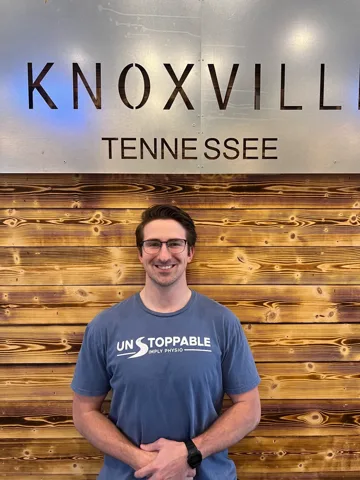
- Guest
- Dr. Tommy Lane
- Credentials
- PT, DPT, CNPT
Discussion Details
In this episode of the Spotlight Series, we sit down with Tommy Lane, PT, DPT, CNPT to learn more about his journey into physical therapy, the experiences that shaped his approach to care, and the leadership role he now serves in as Clinic Director at Simply Physio
Topics discussed include:
- Tommy’s path into physical therapy and what drew him to the profession
- Early clinical experiences that helped shape his philosophy and approach
- What patients can expect during their first visit and throughout the recovery process
- His perspective on building trust, confidence, and strong patient relationships
- Lessons learned through mentoring students as a Clinical Instructor
- What he believes separates great clinicians from average ones
- His advanced training and interests in dry needling and nutrition
- How lifestyle, movement, recovery, and overall health are connected
- Leadership, mentorship, and helping foster clinical excellence within the clinic
- Encouragement for people navigating pain, injury, or setbacks in life and recovery
Whether you’re a current patient, future patient, or simply want to learn more about the people behind Simply Physio, this episode offers a personal and insightful look into Tommy’s story, leadership, and passion for helping others heal and thrive.
Full Transcript
Dr. John-Mark Chesney: Hey, welcome to Stay Healthy Knoxville. Excited for our episode today. I have um Dr. Tommy Lane um on our show. So, uh Dr. Tommy, he is the clinic director here at uh Simply Physio. Uh so, he’s a graduate from UT uh Knoxville uh as far as undergraduate and he went on to get his doctorate in physical therapy um from South College. Uh so he uh also is certified in dry needling and a certified nutritional uh specialist um here and um we’re super excited about having him on the show and understanding some of his background and really get what got him um started and gleaning from some of his expertise. So welcome to the show, Dr. Tommy.
Dr. Tommy Lane: Yeah, thank you John-Mark. Thank you for having me on. [clears throat] Yeah.
Dr. John-Mark Chesney: Well, um as um yeah, viewers are listening, we’d love to uh have you start from the very beginning of um take us back and what draw drew you into the field of physical therapy? Uh was there a certain u story or event that really introduced you to the field or got you thinking that you may want to be become a physical therapist?
Dr. Tommy Lane: Yeah, so I uh was actually uh admitted to UT as an advertising major. Uh, a lot of people don’t know that. And I, uh, went in and, uh, before I even, um, got to my freshman year, I changed my major because I, uh, I played, uh, rugby for many years. Uh, and with that sustained quite a few injuries and had a lot of bumps and bruises that I had to rehab. And so, I was in and out of physical therapy from different injuries, you know, for accumulative total of like a year just when I was in high school. And um and I remember I was uh I was at physical therapy and I was sitting with the uh um the physical therapist that was working with me and uh I said that I was admitted to UT as an advertising major and um and she said, “Oh, I think my my my husband works in advertising.” And I said, “Oh, that’s that’s so interesting.” I started asking questions. So, who’s his biggest client? And uh she said, “Bayer.” And I had like a little existential crisis of like, “Do I want to grow up and have my life’s work be making eye drop commercials?” And uh I just it didn’t resonate with me. And so uh I started you know soulsearching a little bit started thinking and um and I looked back on and reflected on how impactful physical therapy was for me and getting me my sport back my daily life back um and how important that was for me because I remember at one point I was 16 or 17 years old and I had a hip injury and uh my family was on vacation. and we went to Gatlinburg and um and we were going to go walk the strip of Gatlinburg up and down and I remember thinking, “Oh man, like that’s that’s going to suck. I got to walk a really long way and I was not even 18 years old and I remember thinking how awful that felt.” And um and but physical therapy was the thing that was able to give that back to me. Like I I went through PT, did the whole bout and uh and I got better and I back got back to walking fine and playing fine. went on to play rugby at UT and, you know, had more injuries there, too. But, um, and did more PT, but it was so impactful for me that I thought, how cool would it be to be able to to be in that same position and give that back to other people, you know, no matter what it is they want to do. Um, I found that really rewarding and so led me down the path and years later here we are.
Dr. John-Mark Chesney: Um, awesome. So yeah, that was I mean similar path for me is some sport, you know, I was introduced through my own injuries and um playing playing soccer growing up in high school and um and really enjoy being around the clinic and the field and understanding. So um so yeah um well yeah, thank you. Thank go ahead.
Dr. Tommy Lane: I was going to say it’s a common pathway you’ll hear in the PT world. We all end up broken athletes and and uh find our way to PT. Um, and usually it’s like, okay, like you go to a course and you’re like, okay, can I can I be the volunteer because I’m still working on myself, right? [laughter]
Dr. John-Mark Chesney: Yeah. Yeah. We’re all works in projects. Um, so, um, what really part of your career? Um, what do you remember most about maybe kind of take us back to your first kind of treating your first few patients and maybe things that you learned?
Dr. Tommy Lane: [laughter]
Dr. John-Mark Chesney: Well, if you think about like as a as a young clinician, like are there certain things that you think about differently now than you did back then? As far as
Dr. Tommy Lane: Oh, God. I mean, everything. Um, I mean, it’s a um as a as a young PT, I mean, the when you’re in PT school and you’re learning, you know, it’s all pretend, you know, it’s all, you know, tests and fake patients and um there’s no real stakes in the end. And then when you have that first patient that’s looking at you and especially early in your career and that first patient that that’s looking at you saying, “I’m in genuine pain. I’m in trouble. Like my life is affected and they’re looking to you as the expert to then get them better.” There’s that that when you’re first out of school, it’s terrifying. You’re like, “Oh my god, I’m double check everything. I’m going to go home and do research.” Like it’s you you then you kind of have to because you’re still learning in a way. Um and um but over the years I mean build so much confidence and see patterns and and talking about how it’s different now um the one thing I would say now is that there’s a reason they call medicine practice you know uh why how many years of practice you’ve been in and um I think a lot of that is because as a student and when you’re young therapist you think it’s all very black and white like oh you have X I treat you with Y like it’s just very linear binary um then when you start really treating people and actually understanding the problems and and doing those treatments and seeing failures of some treatments, you have to realize that it’s more shades of gray that every patient is different and that every patient responds differently. And I mean, we even see in studies, you know, we see studies all the time that that back this up as well. Um, and that every person really is different. And so, it’s almost like every single evaluation that you get, it’s a bit of an experiment, you know, because we know I’ve treated, you know, hundreds and thousands of people. um you know with different conditions and uh and I’ve treated all of them a little differently because every person’s just that little bit different. It’s generalities. You know, generally I’m going to do roughly the same thing. Um and you know, for whatever condition you have, but but yeah, everyone does respond so differently. So, you you have to you have to put on your thinking cap every visit and uh and make sure you’re doing what’s best for that patient in front of you, not just what’s best for, you know, what you have on paper.
Dr. John-Mark Chesney: Yeah. Well, um maybe thinking back on patients that you’ve made a real impact. Is there any certain patient in particular that comes to mind? Maybe a success story that stood out to you, really stuck with you kind of just emotionally? Anything that come to mind?
Dr. Tommy Lane: Yeah, I think there was one that um that really stuck with me and it was it was a good lesson um you know, in terms of learning about people but also learning about uh pain science. you know, that’s a it’s a route that I like to treat a lot of my patients with and educate them about is the the science behind why we hurt. And um uh I had a patient come to me and she uh she had knee osteoarthritis. Uh she was in her late 60s. She was a widow. Um and she came to me because she went to orthopedic surgeon and uh orthopedic surgeon said uh she’s got the quote bone on bone, you know, and it’s the worst he’s ever seen. And uh and it wasn’t uh and she was very, you know, distraught by by that news. and he said, “You need a knee replacement.” But she had no one at home to help care for her with that knee replacement. So, she’s on her own. So, she was out of options and and she couldn’t do the thing she wanted to do anymore. And so, she came to me as a last resort. She basically said like, “I don’t know what else I can do, like if you can’t help me.” And um and so I did my evaluation and uh and I dug into it and I looked at the knee and I did all my you know ligamentous tests, some arthritic tests, some my muscular tests and and I found that I didn’t really think that her her knee joint itself was actually the main contributing factor to her pain. Um, a lot of that was uh some muscular irritation on the inside of her knee and um and I mean she came in limping. I mean it was 10 out of ten pain at times you know and um um and I found and I and I told her that I was like hey I actually think that a lot of the pain is not coming from the joints coming from these muscles here and I explained the anatomy and I explained how it can hurt and why and and uh and talked to her about that and immediately gave her so much more hope than she’d ever had. like she thought she was just doomed. And um and I showed her a few stretches, a few basic exercises, and literally her next visit, she came in, she says, “I’m basically painfree.” She’s like, “I haven’t” and it’s been years. It was like four or five years of this pain. She’s like, “I’m painfree, you know, for the first time in years.” And is is that me being magic and waving my magic hands over her knee, you making
Dr. John-Mark Chesney: Yeah. Yes. Yeah. Yeah. Exactly. Yes.
Dr. Tommy Lane: Yeah. I’m [laughter] I’m also a wizard. Yeah. Um but like realistically, no. You know, it wasn’t that. It was it was me giving her some exercises, but giving her hope and letting her know, hey, you know, what you find on imaging does not dictate what’s actually going on in your knee and and it’s not going to dictate how I’m going to treat you. You know, I’m going to do my own evaluation, figure out what’s going on. And um um but it was also a lovely uh you know, lesson in pain science. you know, pain is very complex and I you could spend a whole three-month lecture, you know, talking about pain science, but pain’s extremely complex and um you know, just for her letting her know that I think it’s going to be okay and and giving her some things to work on that pain um it made a hu a world of difference for her. And so it’s uh it’s very important to uh I find to to reassure my patients that you know total honesty of what’s going on in my head. How do I think I’m going to help them and and let them know where I’m at with that and I don’t use verbiage like bone on bone and worst I’ve ever seen. You know, right? I also don’t do that. So um but yeah, but that was one that really stuck with me.
Dr. John-Mark Chesney: Yeah. A little disclaimer for those that are listening. So Tommy’s a really good therapist, but his um success and and having that dramatic response is not a guarantee in your results. [laughter]
Dr. Tommy Lane: Obviously, I can’t wave my magic hands all the time. Yeah.
Dr. John-Mark Chesney: Right. No, Tommy is a great therapist though. But I think, you know, there’s a lot to be said though that of uh when somebody has, you know, at least some level of hope and if they’re coming in for a visit, you know, it tells us that maybe they’re skeptical or maybe they have doubts, which is very normal. But if they show up, there’s still some level of uh of intrigue, uh curiosity, and you know, I call that some level of of hope. And we have if we have a little bit of that, if you can foster that and grow that, um you know, there’s some beautiful things can that can happen, right?
Dr. Tommy Lane: Yeah. 100%. 100%.
Dr. John-Mark Chesney: Um well um I’m making a little bit of uh you know shifts um like is um kind of going has more towards today like when you think about um your uh we’ll call it treatment philosophy you know for patients that are or interested patients that are listening to the podcast like how do you kind of view treatment like do you have a general uh philosophy that uh that that you lean toward? towards you know as you’re going about constructing a plan or commencing physical therapy for someone.
Dr. Tommy Lane: Yeah. So I mean I think that uh the main function and metric that I’d like to look for is um what are their main goals? Like what do they want from physical therapy? You know like I’ve I’ve had patients come in with some pretty serious objective findings that are are really kind of scary, you know, like it’s pretty serious stuff. And then um in my mind, my the PT mind for me is going, “Okay, well, this needs to be better. This objective finding I would like to improve upon.” Um but then you find that that’s not their real main metric. It’s well, I don’t really care about this thing. Maybe I can’t, you know, bend my knee all the way or get my elbow just all the way straight or whatever it is, you know. Um they want to play with their kids. They want to, you know, throw the ball with their son. They want to, you know, go on a hike again, you know, whatever it is. And so I really try to tailor my treatments behind what the main goal of that person is. You know, a lot of the times it’s pain. Like we most of my patients come to me because they want their pain to be lesser or gone. And so that is that is usually the metric that we’re working on is just making their pain better with um with their day-to-day function. Um but then still looking at like what makes you tick as a person. like what is it like if I if I took away these three activities like what would what would that really like hurt you if you if that happened and so how can I give that back to you like how can I get you back to those activities you know whatever whatever makes you you and um so getting them at least to that point but then I really like to see if we can’t get above that point as well and so there’s one thing about you know taking the pain away there is that’s great that’s wonderful my patients come in all the time and they tell me like hey I’ve had the first week of, you know, last four years that have been painfree and that’s always a awesome visit. Um, but then I kind of have to remind them it’s kind of like if you’ve taken an antibiotic dose pack, you know, that you start feeling great on day three, but you got five days of pills, you know, um, it’s the same concept with with PT and that, okay, we’re feeling pain free, but now how do we keep that pain from coming back? Like, how do I future proof you? um a course uh a an education group that I like to take um uh continuing education from is is called the Institute of Clinical Excellence and they have a phrase that I’ll steal that I really like and it’s called uh one rep max living and so uh a lot of people they are basically living at their one rep max and one rep max for people that that don’t know is if you’re in the gym how much weight can you lift with this certain movement the absolute maximum you know and basically our bodies are designed to lift as much as we need to. You know, that’s why if you do strength training, the muscles get bigger, you get stronger. You do hard things, the body adapts to it, you know. Um, but if we’re not doing those hard things and we’re not, you know, really challenging the body, it’s not going to get to that certain level of strength and that certain threshold. And basically, you’re living every day at your one rep max because that’s the most you’ve ever challenged your body to do. And so, how can I improve that top threshold? How can I make you not live at your one rep max, but you’re living below that point? to where you know picking up your kid or or reaching for something in the back seat is not going to hurt you. It’s not going to aggravate you because you know you’re much so much stronger than that baseline function of just your everyday tasks. Yeah. And so that’s kind of where I like to get people to is where they’re not one rep max living.
Dr. John-Mark Chesney: Yeah. So it sounds like you’re describing kind of how to make um a more resilient body to
Dr. Tommy Lane: 100%
Dr. John-Mark Chesney: to improve its ability to handle demands. Um and we have to train it to become more resilient so that way one simple lift of you know a child or a grandchild doesn’t you know bring them to their knees you know so to speak.
Dr. Tommy Lane: Yeah absolutely. Yeah. [clears throat]
Dr. John-Mark Chesney: Um so um are there any uh certain things that you find that patients have misunderstandings about recovery?
Dr. Tommy Lane: Yeah. Uh first is that they think it’s going to be uh easy and they think it’s going to be linear. Right. A lot of people think that it’s um you know it’s uh it’s pretty simple that you come in you know once or twice a week and I’ll wave my magic hands again and and then uh people get better. But it’s it’s it’s homework. [snorts] Like the I always tell my patients the most important thing about their recovery is the home exercise plan and trying to get the right recipe of what homework what things are you doing at home that I prescribe to you. Very specific exercises and movements that are going to get you better. Like that’s that’s one of the [snorts] most important things. Um, and then the other thing is that it’s linear. You know, a lot of people think that, you know, with physical therapy, you just every day is just going to be better and better and better. And a lot of people it is, you know, but you’re going to have ups and downs. You’re going to have some some wobbles. You’re going to have some speed bumps. You’re going to have, you know, maybe we’re 3 weeks into a six week plan of care and they come back in, they say, “I don’t know why, but I felt worse the past two days.” And we’ll look into it. Usually it’s because well maybe you didn’t sleep well the night before and you went on for a extra long hike or you know or whatever it was. Um but you’re going to have some speed bumps along the way and that’s normal. I would say 98% of my patients all have speed bumps like that. It’s kind of weird when a patient gets better every single visit. That’s unusual, you know. Um I’ll take it. I’m happy with that, but it’s it’s not the norm.
Dr. John-Mark Chesney: Um yeah, thanks for sharing. Tommy was um interested to since you’ve worked in a few different settings. Um what is it um you know here at Simply Physio we work with one patient at a time so that means we can um focus on our patient in front of us the whole session. What does that do for you as a physical therapist that allows you to maybe treat differently? Like what what why is that an advantage to you and maybe to the patient?
Dr. Tommy Lane: Yeah, I think to to answer that I can kind of tell you about the other models that I’ve been in. So, I mean, I’ve my first job out of PT school, I was in a um uh a model where it was multiple patients an hour. That’s most physical therapy clinics. The the vast majority of PT clinics are going to be a multi-patient model to where one physical therapist will be handling two to even seven like certain clinics will handle up up to seven or eight, you know, nine even patients an hour. Um and with that, you you have to divide your attention between those patients. And the more patients you have, the more you have to divide that attention. And so the worse it gets. And so you start missing things. You start, you know, you you can’t really control all their movements with the exercises. You don’t have as much time for hands-on manual therapy, any special treatments like dry needling or shock wave. You don’t have the time for those things. Um, and so it really does just dilute the experience and dilute how much you can give. Um, and um, and here at Simply Physio, you know, we don’t have that. And so it it really does kind of unshackle uh the physical therapist. And I I stand by that a one-on-one model is the gold standard of physical therapy. This is this is how physical therapy should be done because I mean we are medical, you know, providers and we’re providing a a medical service. And I think with that, we need to really be as dialed in as possible and as attentive as possible. And it allows me to to see more things than uh than I would normally, you know, and catch more things than I would normally. You know, it’s um uh I mean, because we’re human still, you know, we’re we’re smart, you know, but we still can make mistakes. And so, um, having as fewer distractions as possible means I’m so much less likely to make those mistakes cuz I had patients in my first job when I mean I would be four weeks into the plan of care and then I would watch them do a movement and realize it’s been wrong the whole time or they were doing this compensatory mechanism and all sorts of different things and I would just, you know, bonk myself in the head like I should have caught that earlier. But it’s it’s hard to blame yourself when you’ve got to handle 50 other people, you know, and here I just don’t have that problem. Like I I catch those things early on. I don’t have as many head bonking moments because I’m like, “Oh, yeah. I’ I’ve saw this on day one and day two and day three. Like I’ve I’ve caught all this, you know, and and it’s also easy to pivot, too. If a patient’s not making progress, you know, then we’re very easily able to say, “Hey, well, you know what? Next session we’re we’re flipping gears. We’re going to try this. You know, we’re going to go this different direction.” you know, um, and so we’re a lot lighter on our feet in that way. We don’t have to steer this entire crew of techs and PTAs, um, to, uh, and athletic trainers to to all go in the same direction. I can just immediately make a change.
Dr. John-Mark Chesney: Yeah. Yeah. I mean, I think one thing that gets me is, you know, somebody’s had, uh, physical therapy that didn’t help and, you know, they can come away with the conclusion that physical therapy in general is not the answer for me. And you know, and you know, I don’t fault them at all because they don’t really understand or appreciate that um there’s different types of physical therapy and different models and um you know, our you know, goal and hope is that when somebody comes in, you know, that we can obviously that we can help people, but at the very least that we can say like, hey, we’ve given you the full opportunity. There’s been no excuses within what we’ve able been able to offer for you to not have success. And sometimes again it’s not um it’s not the right you know they may not we can’t guarantee their success but we we know we can’t blame it on the model um of maybe a diluted kind of form of PT um that we can really give them the full opportunity you know to reach um you know their health goals um and um find success um in a conservative you know means through you know the model that that we offer.
Dr. Tommy Lane: And I think to piggyback off that, like you said, I mean, no no practitioner can guarantee success unless they’re lying to you, you know, but every every gu but I think here the difference is that we can guarantee you that this is the best bet that you have. Um because it really is. I mean there’s there’s nowhere else like this.
Dr. John-Mark Chesney: Yeah. Um well um maybe take us in with any listener that’s um um interested in you know working with you thinking about just that first session. You know, a lot of people can come into that first session obviously um with a bit of uncertainty, maybe some skepticism, maybe some doubt, maybe just some nervousness. Um so maybe kind of walk us through like when somebody’s in your uh room for the first time, what are you hoping to get out of that session?
Dr. Tommy Lane: Yeah. Yeah. So for me, my my evaluations are a lot of talking. Um there’s a quote that really stuck with me. It was a really talented physical therapist, and I’m forgetting his name. Um, and it might I might have been a physician as well, I forget. But either way, he said, um, shut up and listen. The patient is telling you the diagnosis. And, um, and so that’s what I do a lot is I shut up and listen. And I and I have the patient tell me their their whole story. I want to hear, you know, where the issue started, how it started, how it’s progressed, what bothers them, what makes it better. Like, I want to get as much detail as possible. I’ll spend 20 to 30 minutes just talking to a patient, you know? Um there’s many times I mean most people in their physician’s office they’re in and out in five minutes you know and five minutes is just my greeting usually you know we’re just chitchatting and then and then we really dig into it um and then I’ll spend the rest of the time you know so now I have this you know usually about 80% of an idea of what’s going on just based on what the patient told me and then I’ll spend the rest of the time trying to confirm or deny that was my objective testing and so we’ll do range of motion testing we’ll do strength testing I’ll have special tests depending on you the condition that that is going on. Um, you know, I’ll I’ll go through all of that and then we’ll put all meld all that information together and see if I can, you know, synthesize everything and figure out what is going on, how severe is it, and then come up with a plan that works around that person’s life because, you know, a good example is like I have a patient and he has extremely chronic plantar fasciitis, 25 years plus and um he finally uh just gave in. and he was like I’ve got to do something about it and came to me and you know but he’s also a woodworker and he’s building a deck and so that’s not you know easy on the foot in the plantar fascia and so it’s been you know we we had to design a game plan around him building his deck because I’d asked him I was like is there is that take a pause does that have to continue you know what what is it you know he said that the deck has got to get built that’s not stopping me he’s like and you can’t say anything to stop me so I said understood we’re gonna we’re gonna work around that and so we’ve we’ve come up with a a tailored plan that’s a little unique um to, you know, work around him literally building his deck, you know, and I’ve had patients that they come in and they say, you know, they’ve torn their ACL and they’ve had surgery for their ACL and then they’ve got a big trip coming up and, you know, on paper it seems like, wow, you may not be ready for that trip. So, we we ramp it up, you know, and we we go a little more aggressive. We go a little beyond, you know, the standard just to make sure that we can get them ready for whatever that trip is. Um, and so I really try to listen as much as I can and then confirm with an I what we find and then let’s design a plan around your life, not just what was on paper, you know.
Dr. John-Mark Chesney: Um, what what can a patient expect to kind of leave with, if you will, um, after wrapping up that exam?
Dr. Tommy Lane: Yeah. Yeah. So, my the way I like to uh conduct my initial evaluations is that um at the end of our evaluation after I figure out what’s going on and we’ve kind of come up with a plan, I will always give patients exercises because like I said earlier, the the most important thing is the the recipe of home exercises, like what are the right movements for you to be doing and at what frequency, at what dosage, and and I oftentimes don’t do too much hands-on treatment. That’s just my personal style. Um, that’s the way I like to treat is that the first visit I like to send you home with some exercises of things that I think are going to make a difference and have you report back that second visit and let me know if or not that did help. Uh, because that’s going to be really helpful in me a confirming my diagnosis and then also confirming whether or not the plan that I had formulated is actually going to be making a big difference. And then on that second visit, we will get into some hands-on therapy. You know, I’ll do some some joint mobilizations. We’ll do some uh some dry needling, possibly some shock wave, some some whatever we need to do to get you better. But that first visit, people usually walk out with a lot of education, right? They’re going to know exactly what’s going on. I usually show people on a chart or diagram the anatomy of what’s going on. Um I hope I hopefully I can explain it as thoroughly as possible and they they get home exercises to to then treat that condition. And then and then just reporting back on that second one about how well they did with that and if it made any change. um
Dr. John-Mark Chesney: if um if somebody was on the fence maybe um you know they’re considering coming in but they’re just not quite sure if it’s uh right for them. Well, I mean what would what would your kind of advice be to them?
Dr. Tommy Lane: Yeah, I mean I understand that you know coming into physical therapy and going into a new space and talking to a provider um you know they’re wondering like is this a is it the right place? Is it something that I really need to do? I always tell people that there’s you literally have nothing to lose, right? The you know, we we keep our very our evaluations very accessible for everyone. And the worst you’re going to come out with is a lot of education. You know, the the worst thing the worst thing that happens is that you learn more about uh your body. And that’s the that’s the absolute minimum that you’re going to leave with. Um and it’s always worth exploring, too, because here’s the other thing. I’m not going to offer a surgery. I’m not going to offer a pill. I’m not going to offer an injection. I’m not doing any of that stuff, you know? And so, um, nothing that I do is going to be possibly harmful for you. Like, you’re you’re not going to be harmed by anything I do. Everything I do is going to be gradual and productive for you. And, uh, and non-invasive, you know, and so, um, because if you go into a physician, you say, “My back hurts.” And they say, “Oh, well, let me give you this injection.” Well, what if they miss? You know, um, you don’t want that. And so, uh, you don’t have that worry with me. Um, and so yeah, it’s there’s there’s nothing to lose by coming and just having a conversation, you know, that’s the at at worst you you lose an hour of your your day, you know, and hopefully still walk away learning more than you did before, right?
Dr. John-Mark Chesney: And I think most people too is just recognizing that indecision is a decision. You know, if you’re deciding to um avoid or you know, not commence care, then you are like that is a like a decision. So, um you know, if you’re not happy with where you are, like um for whatever reason, then ultimately there needs to be some sort of um actionable step in a direction somewhere. And I think what you’re saying is like the the most kind of the safest the most conservative, you know, first step to make is is working with somebody like you who um who, you know, looks to heal the body naturally holistically, you know, tap into the body’s ability to heal itself just with some guidance and some help.
Dr. Tommy Lane: That’s that’s kind of like you can even sum up that’s what physical therapy does is we we stimulate the body to to just heal itself and it’s convincing the body to do that you know with with a I mean a good example is like a rotator cuff tendinopathy you know the muscles in the shoulder they get you know irritated over years and and uh you know having some damage to them you know the body has no incentive to heal that until you convince it to do so and so whether that’s with specific stretches specific exercises dry needling shock wave you name it like all those things that can help convince the body it needs to fix itself and that’s that’s how we do it. [clears throat]
Dr. John-Mark Chesney: Um now you’ve mentioned a few treatments just I want to clarify for the audience u maybe just a brief explanation what they are and how you might use them. One of them is dry needling. You mind explain just to our audience what that is and how you might use it.
Dr. Tommy Lane: Yeah. So the the a long story short of dry needling is that they are single filament needles. So there there’s no injection. there’s uh there’s no hollow opening. It’s a solid needle. Uh they’re the same needles as acupuncture needles actually. Um but we use them in a much different methodology. And so um depending on what’s going on and depending on the condition that we’re treating, we use them for different reasons. But in general, dry needling will increase blood flow to an area. Uh it will actually reduce uh irritability like neural irritability. Um it raises what’s called the the pain sensory threshold. And so if it takes this much stimulus to feel pain, you know, and then, you know, walking gets it to right here, you know, maybe a little bit above it, we can actually raise that that threshold stimulus to about there, you know, which is a good thing.
Dr. John-Mark Chesney: You can do more with less pain, which is a good thing. Yeah, which is a good thing. A good thing to clarify.
Dr. Tommy Lane: Yeah, it is a very good thing. And then um and then the last one is that uh it can actually help improve muscular extensibility. So it can actually help loosen the muscle. So if you have a really tight muscle, maybe a trigger point in that muscle, we can actually force it to relax a little bit and improve the extensibility of it. There’s other mechanisms that go on, but they’re a little more detailed nuance. Those are the big three that uh accomplish most of the goals we need.
Dr. John-Mark Chesney: Um and the other one you mentioned maybe just a brief explanation what it is and how you might use it. Uh did you mention a few times shockwave?
Dr. Tommy Lane: Yeah, so shockwave. Shockwave is a uh it’s a it’s been around since about the 80s, but it’s only been the past about 10 years that it’s been adopted in physical therapy practices. But it is a basically heavy acoustic wave. So, it’s a kinetic energy. Um and uh those acoustic waves are then transmitted into the body via an applicator and um those heavy sound waves basically cause little sonic booms in the tissue and that can actually kind of it’s it’s so noxious and intense in a way that it can actually restart the healing process. It can actually tell the body like hey you know we have got to fix this. And so that’s why it’s actually most effective for uh chronic tendinopathies like plantar fasciitis, tennis elbow, you know, any sort of tendinopathy like that that has been around for a long time and the body’s almost given up on it, you know. Um this can help restart that healing process.
Dr. John-Mark Chesney: Awesome. Thanks for sharing. Now, um you I know you also have um a certification um in nutrition. Mhm. Uh so tell us a little bit about how like you know why you um why you went and um worked through that certification and how that’s um how you use that in practice.
Dr. Tommy Lane: Yeah. So uh nutrition is such an important you know aspect of of recovery uh for so many of my patients and you know it’s it’s simple things you know like I’m you know I’m not to the level of a dietitian you know like but I’m not going to prescribe a diet to then treat like diabetes or you know multiple sclerosis or anything like that but what I am going to be able to do is be able to have a patient come in and then discuss with them uh good eating habits and things that we maybe ought to take out of our diet that might be pro-inflammatory, that might be aggravating their pain, making things feel worse, and maybe not giving them enough like the basic fundamental nutritious, you know, building blocks that we need to build things up. You know, we’re made up of millions of proteins and collagen and all sorts of different stuff. And so, um, if we’re not giving our body the right building blocks, uh, with rehab, it’s almost like doing nothing. Like, you’ll see this a lot of time in the gym community. Um, guys will they’ll lift and they’ll lift and they lift and the lift and they’ll, you know, just be like five to six days a week. But if they’re not getting the right diet, if they’re not getting the right sleep, if they’re not getting all those other variables, right, it’s almost for nothing. And rehab is no different. You know, if a patient’s coming in and we’re we’re giving them all the right exercises, but their nut, you know, their diet looks like crap, then um it’s going to be a lot harder to make those changes. is and I found that my patients that I’m able to make some dietary changes with just subtle changes here and there um adding something maybe taking something away um they get better a lot quicker and so it’s a it’s a simple thing and it’s better for you usually I’m going to guide people through just a general healthy diet and um um I find that that’s that’s really useful. So, I got that certification because I wanted to learn more and I wanted to be able to actually, you know, have some um some backing to be able to give this information to my patients and um some credibility.
Dr. John-Mark Chesney: Awesome. Um yeah, I think that’s just a testimony to kind of appreciating that, you know, healing for healing to take place um you know that we have to consider the whole picture, right? Um, and that that’s kind of the specialty of what we do as physical therapists and working here at Simply Physio is oftentimes we can zoom out a little bit more than maybe you know what an orthopedist you know specialist in, you know, in the shoulder would do. Um, and don’t get me wrong, those fields like we need like we if you’re if you need to have surgery, you want somebody who specializes in the surgery that you need, right? Uh but if you’re looking to avoid surgery, there’s a there’s an appreciation that oftentimes we have to, you know, treat the uh the whole system, right? Instead of just one little piece of tissue.
Dr. Tommy Lane: Yeah. There’s an analogy given by one of my PT professors and it basically says something along the lines of a plant. You can water a plant all you want, but if it’s not in the light, it doesn’t matter, you know. And so we might we might be the water. We’re giving the, you know, the the things that it needs, but if you’re not getting the other things, you know, like the light, like the good sleep, good nutrition, it doesn’t really matter.
Dr. John-Mark Chesney: Yep. Um, now you also uh are clinical uh instru clinic instructor, right? For other um students, student physical therapists. Tell tell us a little bit why why um you enjoy teaching and instructing kind of even young um aspiring soon to be therapists.
Dr. Tommy Lane: Yeah, I just I find it I find it very fun. I remember um you know some when I was in PT school kind of reflecting back on my own experiences and had some clinical instructors that I really liked and had some that I really didn’t you know and kind of learning you know what really helped me and what didn’t and um and also being at such a a vulnerable time and that that young clinician’s career and that they’re growing and they’re learning and your clinicals can be so um transformative I guess and and informative I guess the word I’m looking formative for the way that they’re going to practice whenever they get out and and I hope to instill a uh you know an understanding of what the standard of care needs to be at for those therapists and um and everything and hopefully giving them all the tools they need to succeed and finding exactly what it is so that way they can go out into the world and then make a bigger change and and hopefully looking at the the specifics of what they uh may be lacking, you know, and trying to really work on those those weak points, you know, and um and then congratulate the strong points. But but really making sure that that that young therapist because I mean it’s it’s so challenging whenever you you f we mentioned it earlier but when you first start seeing a patient on your own no one else is there to help you it’s it’s very daunting and so you know giving them as many tools that they need to then go forth and then face that first patient and that first year of practice which is also very challenging um I just find very valuable and I find it uh I find it very fun sometimes you know and So, um, but yeah, it’s, uh, it’s enjoyable.
Dr. John-Mark Chesney: Awesome. Well, uh, a little shift in gear now as we, uh, start to wrap up. Uh, what’s something people may not know about you outside the clinic?
Dr. Tommy Lane: Yeah, so I’m uh, uh, I’m a huge Formula 1 fan. Uh, like too much. So, like, it’s probably an unhealthy addiction at this point. Um, but, um, so if anybody’s a big fan of the 2026 regulations, you can talk to me during our session. We’ll [laughter] we’ll we’ll hash it out. Um, but um,
Dr. John-Mark Chesney: have you been to fun.
Dr. Tommy Lane: Yeah, I’ve been Yeah, I’m actually going again in October. So, I’m going to be uh I went to the the the race in Austin in 22 and then I’m going back again in in this year in 26. And um it’s just a it’s a ton of fun. I’ve been a motorsport car, motorcycle nerd for years. I’ve um I’m a hobbyist mechanic, I guess you could say, working on my motorcycle and my I have a 1996 F-150 and so that thing has some some uh projects it needs done and so um big gear head. Uh I love that stuff and so uh yeah.
Dr. John-Mark Chesney: Um awesome. Well, thanks for sharing. Um so would like to leave with uh with our listeners. So, if you had one piece of advice just to help people stay healthy, what would it be?
Dr. Tommy Lane: Get better sleep. That’s like such an underutilized thing. Um, you know, obviously eating healthy, getting exercise, all that stuff, but we’re learning more and more with research and um and seeing how poor everyone’s sleep is that how important good sleep is. And it’s relatively easy to to get the to set yourself up in the right environment to get good sleep. Yeah. And so that’s the one of the easiest most straight you do it every night anyways and so why not do it a little bit better and the the health benefits that come with that are staggering and um yeah I mean psychological too and uh so yeah get good sleep.
Dr. John-Mark Chesney: Awesome. All right. And then I always end with the same three questions here um to wrap up the show. The first one is what’s your favorite uh restaurant here around Knoxville?
Dr. Tommy Lane: See I’m such a foodie. That’s another thing that to know about me as I’m a huge foodie, so it’s really hard for me to pick a favorite. But top of my head would have to be Emilia in Market Square. It’s an Italian restaurant. Um, and you got to get the pine nut pasta. They make a pine nut pasta that I have not been able to recreate because it’s just I don’t know what they do, but incredible. So, um, probably Emilia. It’s always a good time.
Dr. John-Mark Chesney: Okay, we’ll have to try that one. Um, and then, um, what about favorite spot maybe around Knoxville when you got some free time to go explore, hang out?
Dr. Tommy Lane: Oo, another one that’s also really challenging. Um, honestly, I think Ijams. I love Ijams, especially the quarry over at Ijams, like a hot summer day. Um, and, uh, I think what’s what’s the the formal name of the the quarry? I forget, but it’s me.
Dr. John-Mark Chesney: Me.
Dr. Tommy Lane: Yeah. So, Meads Quarry. Yeah. Um, and so, uh, I go over there and paddle board around, and that’s that’s like a little hidden gem of a place, and it’s it’s always really peaceful and nice.
Dr. John-Mark Chesney: Okay. And then last question, uh, this is more of something that you have not done, like a bucket list item, um, something that you’re hoping to do soon, um, to experience maybe around Knoxville or greater East Tennessee area.
Dr. Tommy Lane: Yeah. And so in the I don’t know the first one I go to is I don’t know if it’s sounds silly but making a trans-America motorcycle trip that is that’s always been a a bucket list. I want to do a coast to coast. So okay I have I’ve done a few long trips. I’ve done a thousand miles in a day up to Northern Michigan. Um it’s called an Iron Butt. Um, but I uh um I would love to do a uh like a Ma like a Vermont Maine to Los Angeles, San Diego, you know, all the way across the country. Um see all the biomes change and uh but that’s a that’s one day. That’s going to be a that’s going to be a two week. I’m going to need some time off. John-Mark.
Dr. John-Mark Chesney: Okay. [laughter] I thought you said one day. You do it in one day at first.
Dr. Tommy Lane: Oh god, no. Oh no. There’s no way. [laughter] No. That’s like that’s that’s that’s Yeah. My my thousand mile trip because of rain and breakdowns and everything took 22 and a half hours. We don’t need to [laughter] I’d be looking at 38 something like that.
Dr. John-Mark Chesney: Certain deaths.
Dr. Tommy Lane: Yeah, certain death.
Dr. John-Mark Chesney: Yeah, exactly. There’s no way I make that. Yeah. [laughter] Well, awesome. Well, thank you for sharing, Tommy. Thank you um uh for our audience uh for listening. you know, if you’re um listening here and um are intrigued with uh Tommy’s approach uh would like uh to get on his schedule, uh then feel free to visit our website uh simplypt.com um to request an appointment here with uh Dr. Tommy. Uh thank you Dr. Tommy for sharing just your insight and your stories, personality. We appreciate you um having uh you on the team and your leadership as well.
Dr. Tommy Lane: Oh, thank you John-Mark. This is fun. I appreciate it.
Dr. John-Mark Chesney: Yeah. Uh and to our listeners um and around Knoxville, stay healthy, Knoxville. All right. Thank you, guys.
Dr. Tommy Lane: Thank you.