
Weeks 1–2
Pain
Calm the pain down.
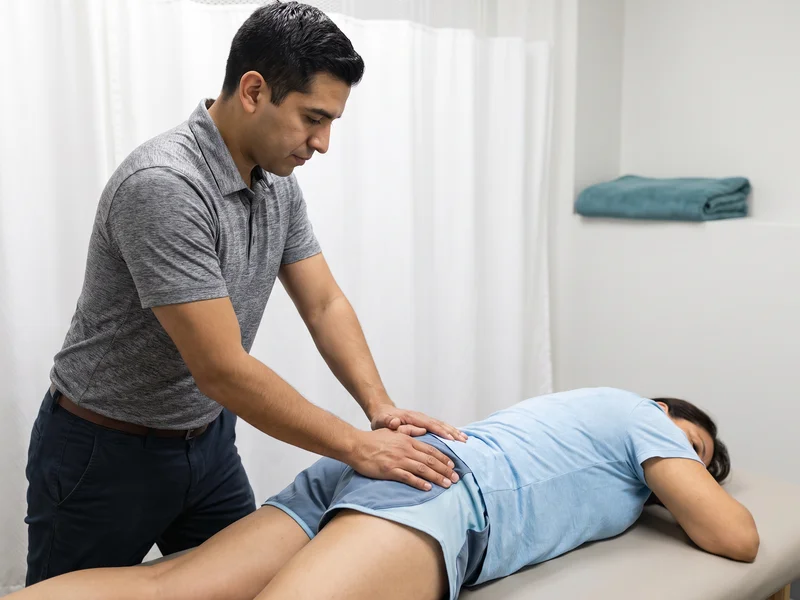
Hands-on care controls post-op swelling and pain, and gets your knee moving safely from the very first visit.
What We Treat
The knee that still doesn’t feel like yours, on the field, on the stairs, on a quick turn. It’s fixable, and it starts with a thorough evaluation, not a guess.
Sound Familiar?
Two or more? Keep reading.
Why It Happens
Your ACL is the ligament that keeps your knee from shifting or buckling when you plant, pivot, or land. When it tears, from a sudden twist, a hard landing, or contact on the field, your knee loses that stability. Everything around it, your quad, your hamstring, the surrounding joints, has to work harder to make up for it.
Rest alone doesn’t fix that. It takes a real, thorough evaluation, and for a torn ACL, close coordination with your surgeon or physician, to build a plan around your specific knee. That’s why a generic exercise sheet so often falls short: it treats the symptom, not the mechanics behind it. Find the real cause, and the fix gets obvious.
The Honest Truth
Nobody regrets starting too early. Every week, someone in our clinic says they regret waiting.
How We Fix It
Every plan has an endpoint. Here’s what the four phases look like for a knee recovering from an ACL injury or surgery.
Weeks 1–2
Pain
Hands-on care controls post-op swelling and pain, and gets your knee moving safely from the very first visit.
Weeks 2–8
Prime
Guided mobility work restores full knee extension and flexion, the foundation everything else is built on.
Weeks 8–16
Perform
Progressive strengthening rebuilds quad and hamstring control so the knee can trust itself under load again.
Weeks 16+
Prevent
Sport-specific movement, cutting, jumping, pivoting, gets tested and progressed before you’re cleared to return: that’s the endpoint, not just another appointment.
One-on-one time, a real evaluation, and a plan with an endpoint: that’s what keeps patients coming back and referring their family.
Rated 5.0 on Google · 553 reviews
Week 1: couldn’t fully straighten the knee after surgery
Week 16: running again, brace-free, and progressing toward full return to sport
Questions, Answered
Not always, and it depends on your knee, your activity goals, and what your surgeon or physician recommends. Some ACL tears are managed without surgery, others need post-op clearance before therapy begins. Either way, a thorough evaluation maps out where your knee actually is right now, and we coordinate directly with your surgeon when surgery is part of the picture.
Yes, and early, guided movement is part of what protects your recovery, not a risk to it. Total immobilization tends to leave the knee stiffer and the surrounding muscles weaker. The key is dosing the right movement at the right stage, which is exactly what you get one-on-one with a Doctor of Physical Therapy, every visit.
It depends on whether your ACL was managed surgically and what you’re returning to, but ACL rehab is a longer process than most injuries, often several months, not several weeks. A full plan runs through all four phases, Pain, Prime, Perform, and Prevent, with return-to-sport testing built into the Prevent phase before you’re cleared. You’ll always know which phase you’re in and what’s left, not an open-ended string of appointments.
Book Your Visit
Request a time and a real person calls you back, usually within two business hours. No phone tree. No ‘someone will reach out.’ Just a plan.
5 · 553+ Google reviews
Typical response: under 2 business hours
Step 1 of 5
That’s the hard part done. We’ll call during business hours to lock in your time. Most people are on the schedule same week.
Visit Us