


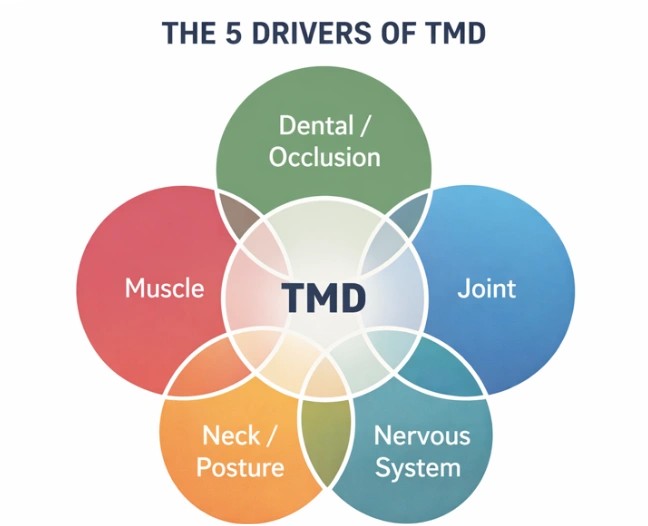
Driver 1: The Joint and Disc — Why Does My Jaw Click, Pop, or Lock?
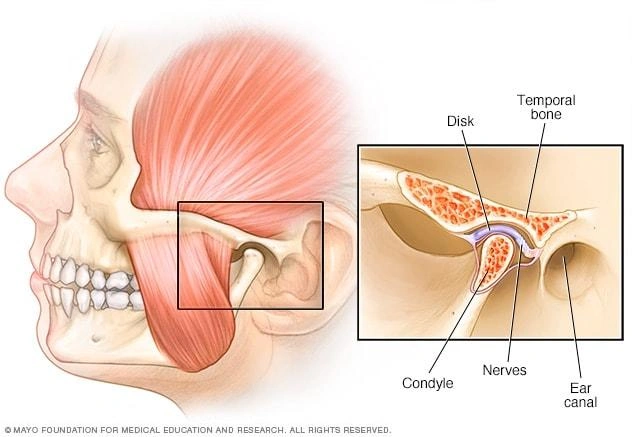
The short answer: a small cushion called a disc inside your jaw joint isn’t moving the way it should. When you open your mouth, the disc slips slightly out of position — and your jaw clicks, pops, or catches as it tries to find its way around it.
You might notice it as clicking, jaw deviation to one side when you open, brief locking, or a feeling that your jaw doesn’t track right anymore. I tell patients all the time: clicking is common, but it isn’t normal. Common just means a lot of people have it. Normal means it’s the way the joint was designed to move. Those are two different things.
Treatments aimed at this driver — manual therapy of the joint, and specific exercises that retrain how the disc moves — can be very effective when the joint is the main issue. But if the joint is being loaded badly by your posture or your muscle tension, just working on the joint won’t hold.
Driver 2: The Muscles — What Causes Jaw Muscle Pain and Tension Headaches?
Most jaw muscle pain and tension headaches come from the same source: a small group of overworked muscles that move your jaw. When the masseter (at the angle of your jaw), the temporalis (at your temples), and the pterygoids (deeper, jaw muscle) are tight, overactive, or in spasm, you feel it as soreness in the jaw, headaches at the temples, pain in front of the ear, or a constant feeling of clenching.
There are also several neck muscles — especially one called the SCM that runs down the side of your neck — that can refer pain right into the jaw, the ear, and the face. This is one of the most common reasons people are treated for “ear infections” that aren’t actually infections.
Treatments aimed at this driver include massage, dry needling, manual therapy, and yes, Botox. They work. But here’s the thing about treating muscles in isolation: muscles tighten for a reason. If you relax them but don’t address the reason — the joint, the posture, the stress — they’ll tighten right back up. That’s why Botox helps for a few months and then the pain comes back.
Driver 3: The Neck and Posture — Can Neck Pain and Bad Posture Cause TMJ Pain?
Yes — and it’s one of the biggest reasons jaw-only treatment fails to hold. When we treat TMJ at our clinic, ninety percent of the time we don’t start with the jaw. We start with the neck. Most patients are surprised by that.
Try this right now. Sit however you happen to be sitting. Open and close your jaw a few times — notice how it feels. Now lean way forward, drop your head, and round your shoulders. Open and close. Now sit up tall, ears stacked over your shoulders, and try again. Same jaw, three different positions, three different experiences.
When your head sits forward of your shoulders — which is where most of us live, between phones, screens, and steering wheels — it pulls your lower jaw back and up. That changes how the joint loads and how the muscles fire. Research using muscle‑activity readings has shown clearly that forward head posture changes the activity of the jaw muscles.
If your neck and posture are part of the problem, no amount of work on the jaw alone will hold. You have to give the jaw a stable base to sit on.
Driver 4: Teeth and Bite — Is Teeth Grinding Causing My Jaw Pain (and Do I Need a Mouth Guard)?
Sometimes — and that’s the honest answer most people don’t hear. Teeth grinding (bruxism) and bite problems are a real cause of jaw pain. If you wake up with morning soreness, if your teeth are worn flat, if you have cracked teeth or pain when you bite, this driver is likely in the mix.
A well‑fit night guard can be very helpful here. So can addressing a true bite problem. But not everybody needs a mouth guard. It really depends on what is contributing to your pain. I see patients all the time who’ve been wearing a guard for years and aren’t any better, because the dental driver wasn’t the main one. And I see others where the guard was exactly the right move but it was treated as the whole answer instead of one piece of the whole answer.
I leave the dental work to dentists. My job is to figure out whether the dental piece is the main driver, a contributing driver, or not really a driver at all.
Driver 5: The Nervous System — Can Stress and Anxiety Cause TMJ Pain?
Yes — and it’s often one of the biggest pieces of the puzzle, even though nobody wants to hear it.
Your jaw doesn’t operate in isolation. It’s wired into the same nervous system that handles your stress response, your sleep, your breath, and the constant background calculation of whether you’re safe or under threat. When that system is dialed up — when you’re running on poor sleep, a tight deadline, or shallow chest breathing — your jaw muscles get the signal to brace along with everything else.